This year, De Brakke Grond is taking a new step in its collaboration with Mu.ZEE, the museum for art in Belgium from 1880 to tomorrow in Ostend. This collaboration will run - in parallel with the renovation of Mu.ZEE - over three years and will each time start from one central question: what stories can a Belgian museum collection tell in a Dutch, non-museum context?
Each year, a different Dutch curator is invited with the request to take a fresh look at the collection and develop an exhibition concept from their own practice. This second edition In Frequencies We Cannot Name: Language, Sound, Silence is curated by Rita Ouédraogo and lands at the Brakke Grond from 7 March to 10 May 2026.
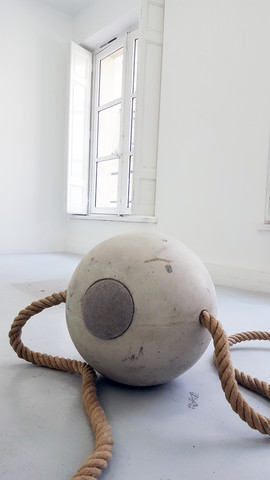
The exhibition will bring together the work of 15 artists - from established artists like Otobong Nkanga to up-and-coming talent like Pei Hsuan-Wang. The exhibition will be activated with a three-part public programme: several artists will be invited, for the duration of the exhibition, to elaborate on their work and engage in dialogue with the local context.
In Frequencies We Cannot Name: Language, Sound, Silence departs from the idea that language is never neutral: it bears traces of power, colonial history and the limits of translation. The exhibition explores how we experience cultural expression when it cannot be immediately understood, and why precisely that non-understanding can be valuable. Here, the lack of direct legibility becomes not a deficit, but a space for encounter and other forms of knowledge.
The exhibition's curatorial framework builds on the theories of thinkers Édouard Glissant and Rizvana Bradley, among others. Glissant's concept of opacity refers to the right to remain opaque and not need to be fully explained or translated. This idea opposes colonial ways of seeing and categorising, such as ethnographic documentation and missionary translations, which determined what was recognised as intelligible or meaningful - and which carry over to today in how cultural ‘others’ are approached. By extension, Bradley's theory of anteaesthetics challenges Western aesthetic norms. Bradley argues that Black and Indigenous cultural expressions do not arise within dominant aesthetic systems, but precede them or function outside them. They do not exist as deviations from a norm, but as complete, autonomous systems of meaning with their own logic and integrity.
In Frequencies We Cannot Name invites us to approach these cultural expressions without trying to translate them into familiar frameworks. Opacity here becomes not an obstacle to be overcome, but a conscious position - and a form of cultural self-determination.
The exhibition brings work by Younes Baba-Ali, Sammy Baloji, Saddie Choua, Joris Ghekiere, Roland Gunst, Randa Maroufi, Jacqueline Mesmaeker, Jean Katambayi Mukendi, Maryam Najd, Grace Ndiritu, Otobong Nkanga, Léonard Pongo, Pascale Marthine Tayou, Pei-Hsuan Wang and Patrick Gaël Wokmeni to Amsterdam.
Free admission